Gardening Mistakes, Misconceptions & (Mis)guidance
Updated: 7 hours ago

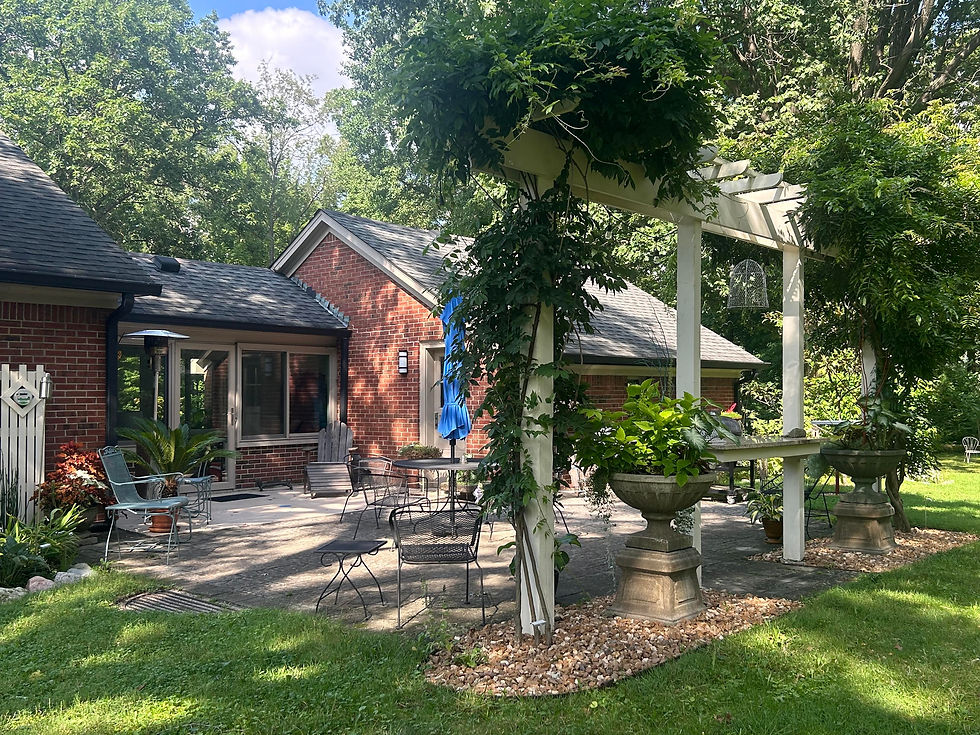


(top) fall (L) and late spring; (2) back patio summer; (3) partial front mid summer, (4) front after every heavy rain; (5) view back towards house (summer) from area that floods; (bottom) out front view during window replacement (24 Oct 2024)
All from my place and all contrary to the title. Included to give you an idea of the look I prefer since I refer to "my style" several times below, although it is impossible to give a true feel since only 2D visual and there are literally countless very different and interesting general views on property, never mind the seasonal variation, and always only a snapshot in time.
There is also a scrolling display of other views (specimens and broader) posted under CLASS (see main menu bar).
Moreover, to help you imagine better my nearly 3-acre spread -- here since 2010, have a 1,800 sq. ft. 1947 ranch house well off the road, an intermittent stream (my biggest water feature, sometimes too big, it floods, see 4), several wild areas including a 1/4-acre original wood and 50 beds (1,000 sq. ft. to <50),150 stand-alone specimens, 19 genera 130 specimens of conifers and gymnosperms (110 spp. & cvs.), a dozen roses (down from 50ish), several hundred labeled plants,
>100 Midwest natives, lots of fragrant plants, >40 tons of boulders (all moved here by me),
lots of weeds (many of them beautiful) and the place is always being rethought. Once I removed the invasive Asian bush honeysuckle and wintercreeper from the wood, along with the too crowded sugar maple saplings to permit permit more light (E), the suppressed native wildflowers reappeared (e.g., mayapple, trout lily, bloodroot, prairie trillium, et al.).
This month's rant will focus on what prevents us from being better gardeners -- Being A Better Gardener is also the title I use for my occasional gardening class. To shorten the piece I will mainly employ an outline-comment format rather than standard prose. I hope it will not come across as rambling. The writeup is based on a handout for a PowerPoint talk I made but have given only once even though undoubtedly at least as important as the many topics on which I have been asked to present. I will start with the GARDENER (us) since all the categories directly relate. We are often our own biggest impediment. Other than that focus the topic categories as presented below are not rank-ordered, but there is some emphasis and overlap, as well as differentiation in relevance to each of you. And this rant deals specifically with home gardening not farming, although some parts do relate. I will also need to go longer than usual. Lucky you, or perhaps I should say brace yourself :) -- If interested in a fair critique of farmers and farming, refer to my Aug 2022 rant or the writings of Wendell Berry and Wes Jackson. Berry died hours before this posted :(
I have tried to promote plants and good gardening in the decade plus I have maintained this gratis website and through my various associated activities. To be clear, by good I mean beautiful, sustainable, multiple season, appropriate and utilitarian. Unfortunately, my teaching effort has been frustrating because (1) we are NOT a gardening society, by interest or opportunity, and becoming less so. I have no doubt that <1% of the general population are gardeners of any sort, nor is that small percentage of the population uniform in experience, ability or outcome -- very few of the <1% are as talented and knowledgable as many of them presume (illusory superiority). Moreover, our general and continuing disconnect from as well as disrespect of the land and the natural world has had and will continue to contribute to ecological ruin. As Aldo Leopold told us not long after WWII, The modern dogma is comfort [convenience] at any cost. (2) It is rare to find a person (young or old) who appreciates being told they are or might be wrong, i.e., able and willing to take constructive criticism, that there might be a better way, yet commonly there is. (3) Equally rare are those who want or can handle being told they are sloven, slobbish and/or wrong (i.e., that their place is a mess or weedy even when an objective assessment would conclude as much). An underlying issue is the fact we often are reluctant to change and do not want to "learn" (i.e., hear something other than or different from what we want to hear). I suggest this is true in gardening largely due to the fact that much garden learning and most remedy refers to upkeep work (i.e., MAINTENANCE) and change, thus an unwanted and inconvenient truth, unpleasant to hear and insulting when told, especially so for thin-skinned recipients. Think learning pain. The truth/reality can hurt, often revealing and shattering illusions as well as causing embarrassment or shame. Some of those who do not like hearing it would like to punish the messenger / messager. HOW DARE HE? I refer to it as messanger. Q: is your reaction upon hearing something different from what you believe (a) rejection or (b) a curious "wonder why he/she said that?" and importantly what are you basing your stance on? Is it experience or merely desire, and are you capable of making a fact-centered/objective assessment? An example I use to explain the behavior is how a child reacts upon being told that their room is messy. Some will deny and get defensive (often mad), some will be embarrassed (though often unchanging, even when punishment looms), whereas some (but not many) will accept the assessment, tidy up and learn from the experience (the training). That last group includes especially those whose goal is to improve, which is more easily done with good teaching/coaching and examples, as will be clear from studying the categories and comments that follow. More of us should strive to be in the last group.
Too easily and far too often we allow ourselves to believe the made-up and fall for the pleasing propaganda. Further, people are quick to judge, but few are qualified to do so (i.e., inexperienced and unknowing). How can you say that something is better or best when you know little to nothing about the other. It is an absurd notion yet it seems the norm. And what if your knowing involves little more than a name? If so, why should that opinion / that like be considered or of interest to anyone else? I have found that this much is certain, if you want to make someone mad, try impugning their taste, their judgment of beauty and good -- subjects that have both teased and frustrated philosophers forever.
To get the message across, my writing style is attention getting and hopefully persuasive, plus I have no problem calling out ill-advised/foolish behavior, deficiencies, inconvenient facts and poor effort/outcome. My goal is to make you think and I suggest you reread. Good reference resources are indispensable. Moreover, anything worth reading or watching is worth reading or watching again -- new insight with a different perspective.
Perhaps my candor is too much for you. Dismiss and criticize me if you wish but I'm purely trying to help, making available free and commercialless advice based on my extensive training and experience -- almost seven decades and counting. At least I try. Again, you are welcome. I do what I do for the small community of gardeners, although others are welcome to join and take advantage of the information. And I do so with the environment in mind -- we all should. Whether or not you take advantage of the opportunity I present is your decision. Think horse and water. Related, praise is good but I always admired the coach who could tell a player, "You can do better." I admire even more the player (in this case gardener) who can take the criticism and use it to get better. The sulking woe is me attitude is not productive. Focus on the message. Performance review with the intent of improvement -- none are so blind or deaf .... Again, I am discussing gardening but as I have pointed out many times, there is a lot of commonality with gardening and life in general.
I need to add that for the most part I am not talking about absolute rules, rather best practices. Any serious gardener should want to know if they can do better, if there is a better way or thing (methods & materials). A few of these will vary by location -- all gardening is local. And I am NOT trying to be mean (just direct speak) nor am I necessarily referring to you, but perhaps I am. If the shoe fits.... Those brave enough to self-reflect and wanting to be A BETTER GARDENER (i.e., have a better garden) read on. You are the reason I do this. As for the sharing/the gifting, you are welcome.
THE GARDENER vs LANDSCAPER - they are not the same (I am both and hardcore); gardeners deal mostly with botany, the plants; I have met a few talented landscapers but most know diddly-squat about plants but how could you discern their ability?; like, want and desire does not equal know, you don't know what you don't know no matter your cocksurenes and we give our trust too freely; plants are more than decorative and gardening is more than plants; as for the 3Ms, USER ERROR, our choices (the what, how, where, when, who) are the fault rather than the plant or place; our failings include being impatient, hidebound, biased, stubborn, sloven, hubristic, as well as change averse and not observant; ignorant and reluctant to accept criticism/advice, yet quick to be foolish and defend the foolishness; if worthy, share your knowledge and garden, we need more gardeners, especially the good kind and younger, too; Q: why is it that garden clubs are dominated by older white women? an accurate answer includes harsh facts and societal roles that date from our hunter-gatherer days; no matter how smart and dedicated you are or how long you live you will almost certainly never get close to knowing anything close to an elite master (a plantsman) but you can easily distance yourself from the pack; the real test is you against yourself and Mother Nature; to be clear, plantsman as I use it IS NOT gender specific (i.e., I mean mankind)
WATER - amount, especially how and when supplemental is applied; apply to promote deep rooting; do you know the per minute discharge from your spigots(s)?; damaged tissue cannot be fixed and once you see color change it is usually too late; water outdoor potted plants daily, especially in hot weather; as given to us by Mother Nature water is NOT a waste product yet most gardening and plant problems involve water, think of it as the paradox of water and mankind
LOCATION - short of relocating there is only so much one can do; commonly we create too much shade and give up sun (E), but too much of either is restrictive and problematic; every location is different AND all gardening is local; not considering position/siting as regards lighting, especially backlighting opportunities; not knowing or ignoring the history and short-comings of your site (e.g., space, soil, exposure, drainage, climate); issues and limitations such as planting under utility lines or in right-of-way/easement (they and what you put there could be problematic, genetic potential/behavior of the plant{s} and authorization)
NOT THINKING AHEAD - failure to plan and prepare, think eventually and be objective; most people are spatially challenged thus poor siting is common; other concepts that should be considered include maintenance, lag effect, bias blindness, better (and how would you know?), avoidance/consequences; e.g., not planning ahead means missing opportunities like winter / early spring bulbs, et al.; indeterminate growth is addressed below
TAKING & ACTING ON ADVICE FROM THE WRONG PERSON/SOURCE - be leery of suggestions from anyone trying to sell you something or a service, "it" is not always bad but one needs to be careful (caveat emptor) and one should avoid fools, but how to know?; labels and online info often inadequate and/or not trustworthy / irrelevant to your location; good advice is in short supply; it is an honor to be asked for advice since it implies trust, we owe it to the person to be honest; do not presume garden center owners or their employees are gardeners, never mind good gardeners; if they are, lucky you, businesses are that first -- exist to get you to give them your money; do not presume that being in a plant related club means the person is a good gardener, nor does one need to be in a club to have gardening friends; common or traditional DOES NOT mean best practice, nor does it always mean bad; only a fool would rely on the gardening and climate info in Farmer's Almanac (see my Feb 2020 rant); the wise counsel more often than not is NO/DON'T, yet ...; Wanting to have one's say (an opinion) is human nature but do not not mistake it for experiential (i.e., advice)
NATIVE & POLLINATION NAIVETE - fanciful self-righteous delusion based on want and half-truth; very misguided; open your eyes and do the math; the devotees are and were gullible and foolish (think Pied Piper) and their revered natives-only guru is a cherry-picking charlatan (think pseudo ecologist); related, most "garden prairies" are made by people who have never seen or been in a real prairie (several general kinds but they are ALL different) and could not distinguish one from an oldfield; da Vinci's Mona Lisa is a manmade rendering, not a women, same with a garden prairie; I will continue to mock the foolish puritanical and nationalistic cultists and will expand on this topic in an upcoming post
USDA HARDINESS MAP - wanting stability (a normal) and a simple answer to a complex Q and too quick to accept as truth a suggestion simply because you agree (bias confirmation); for half of the non-exotics you should consider irregular hydration, especially wet/saturated clayey soil in winter, is as or more important as a limiting factor; the climate is changing so fast that historical norms (pre-2000 data) are largely obsolete and irrelevant; the extremes and rapid change cause most gardening climate related problems, not the averages we fixate on; Law of Independent Events (i.e., the last coin flip does not effect the next outcome, except in gardening it sometimes can and does, e.g., lag and cumulative effect)
GUESSING/MAKING IT UP RATHER THAN SEEKING EXPERT ADVICE or NOT FOLLOWING THE ADVICE - related to but different from #5; uninformed opinion v. experiential knowledge (wisdom), there is a big difference; my idea so it must be a good one lunacy; again, beware hubris and illusory superiority, "Knowing a little, but thinking you know a lot" (Adam McKay); good broad-based advice applicable to where you garden can be difficult to obtain, if available cherish and use it; always be thinking PURPOSE, WHY? and is this what you are considering the best choice/option for your place?
CHOOSING THE WRONG EXAMPLE/STYLE TO EMULATE - unfortunately, few good examples; those in your neighborhood could be awful (usually are, for multiple reasons) but how would you know?; monkey see, monkey do; mimetic desire and conformity; common does not necessarily mean better/best but it could (again, how would you know?); there are few straight lines in nature but lots in the poor examples; It's not what you know that gets you in trouble, it's what you know for sure that just ain't so (Adam McKay)
INADEQUATE MAINTENANCE - poor oversight; not knowing what to do, how to do it (or when) and sloth; FACT, gardening involves lots of hard work and upkeep otherwise one will always very quickly end up with clutter and weedy chaos but it is possible to morph that into naturalistic wonder but it requires knowing the flora, ecological understanding, talent, effort and a willingness to get your hands dirty -- all uncommon; there is an excellent reference book entitled The Know Maintenance Perennial Gardening (Roy Diblik) but NO maintenance is a pipe dream; the weeds and entropy are relentless; see also FOREVER MYTH below (#25); too often we inadvertently and foolishly create more maintenance (e.g., not attending to weed removal until AFTER they set and drop seed, or allowing specimens to get too big); part of a wise productive strategy is to do something every day, even if only minimal; AVOIDANCE, very often you are responsible (the source of/cause for) the weeds you get and battle; be particularly observant around recent plantings and disturbed soil (vacancy and opportunity); some gardening activities are once and done but, since the total number of things to do is so numerous, it seems less; if neglected too much and for too long a formerly good garden can be unrecoverable; proper care requires as much knowledge and a different (and sometimes more) knowledge than choice (the start); important to occasionally get away to prevent burnout, returning fresh and invigorated
IMPROPER PLANTING TECHNIQUE - too often (esp. trees) not planted correctly, usually not deep enough thus commonly associated with volcano mulching; when planted too late in the growing season (a) can result in frost heave and (b) not enough time to acclimate -- can exacerbate transplant shock; redo (replanting) is not something one should have to consider and time can prevent that possibility; common mistake of planting crews which begs the Q why isn't there more quality control?; seems like every planted red maple I see is planted too shallow thus destined to have root and health issues (you could not give me Acer rubrum, weedy "native" {Dirr was right} and far better options are available); anthropogenic, USER ERROR, not the fault of the plant; common or traditional DOES NOT mean best practice; for multiple reasons, I strongly recommend an exclusion or framing zone around every specimen with the understanding that (a) it likely will need to be enlarged over time and (b) it WILL require at least annual upkeep, especially extraction and edging
IMPROPER PRUNING - what, when, how, who; pruning can both stimulate new growth and harm; form can be ruined if done wrong; often best to wait until after "the show" to do it; not enough pruning and most of what I see would qualify as butchery; rarely able to overcome the wrong plant species for the available space (i.e., upcoming problem you created); pruning is one of the more challenging aspects of gardening but one of the most satisfying and rewarding
NOT TAKING TIME TO OCCASIONALLY REMOVE WEEDY WOODIES (trash species of trees, shrubs & vines, both native & exotic) - prevent establishment; unable to identify/distinguish (lack of training/ability) even many who think themselves excellent gardeners; often not actually removing (i.e., not eradication, more like selective pruning, removing part or all the aerial portion but the established living root system still there able to produce new growth); permitting grow-throughs and grow-overs; with biocide one must still deal with a skeleton; avoidance is better
IGNORANCE OF THE FACT THAT ALL WOODY PLANTS HAVE INDETERMINATE GROWTH - label inaccuracy but (again) how would you know?; SPACING miscalculation, size is a spherical/3D measure; far too many big trees chosen for small properties, many species are best left to parks and woods; also refer to my Oct 2021 & Feb 2024 rants
CHOOSING BASED ON A SINGLE ATTRIBUTE - not considering a species full profile (before inviting in); color or nativity as a first and often only interest/concern !!!; other key factors that need to be considered include texture, form, phenology & duration, longevity, fragrance, maintenance issues, multiple season appeal, prone to ____; again, how would you or the source you are getting "advice" from know? and is it really applicable for you/your place?
NOT ATTEMPTING TO LEARN WHETHER A PLANT IS INVASIVE/AGGRESSIVE OR HAS OTHER DRAWBACKS BEFORE OBTAINING OR KNOWING AND IGNORING THE WARNING - subset of #8 and prevention is always better; be especially cautious of ground-covers, vines & grasses but even 'bad" can be beautiful; the plant police (phytofascists) do not like it when the more sinister sounding term invasive is used to describe a "native" -- hogwash!; many of our weeds are native
REPRODUCTIVE STRATEGIES - letting weeds go to seed thus developing an ongoing seed bank; ignorance of asexual methods; goal of every life form is to live and reproduce (a form of success), just that some are better at it while some do not play well with others (greedy in a deleterious way, like many people!); if there is an open space/a vacancy, and dependent on available sunlight (E), Mother Nature WILL put something there, even when the ground is rock or contaminated; pay attention as what appears in the vacant space is informative, I find it exciting; take home message, prevent Her OR try to occupy the space with your choice; no doubt this is the wisdom behind and basis for the Cottage / English Garden style (i.e., take/occupy or it will be taken, at the same time substituting one type of maintenance for another while having more plants to enjoy when done)
SPRING-LOADED - forgetting about (ignoring) the rest of the year, a good gardener would not; for most people the gardening season is spring to about Memorial Day; water loving plants (selected in spring) struggling or dead in a dry summer / autumn (the future); a good garden, regardless of size, can and should have year-round interest; late summer through early fall as well as winter are the most challenging times (test of talent)
BELIEVING (w/o Q) THE HYPE/PROPAGANDA - gullibility; irrational denial and wanting to believe what you want to believe, facts/reality be damned (e.g., desiccation spray, mosquito shoo, expandable hose, irrigation systems, wound paint, sucker compounds, landscape fabric {geotextile}, alluring cultivar/trade names, monoculture, tree gators, rain barrels, wooden raised beds, nativity, etc. -- refer to my Aug 2023 rant PHYTOFASCISM); thinking your garden is a natural area -- NOT, it is manmade. SIDE NOTE: propaganda was what Edward Bernays originally called public relations, the change happened because Goebbels/the Nazis liked and spoiled the word. Checkout the exceptional 2002 BBC documentary The Century of the Self
PRESUMING THE ANSWER TO A PROBLEM IS EVER OR ALWAYS IN A BOTTLE/JAR, BAG OR BOX - gullibility, laziness/sloth, synthetic fertilizer (I do not use the stuff), biocides (sometimes required but caution should prevail); organic supplements & mycorrhizae is the way to go, along with choosing wisely (what, where, when); the plants physical condition and behavior are diagnostically telling; if you have aboriginal soil consider yourself fortunate, most modern home lots do not (post 1970+), then more likely dirt and backfill deficient in organic material; soil has critical living components which can be killed; as regards poisons DO NOT (use avoidance and repellents); fire can be an effective maintenance tool in some situations
HORTICULTURAL & LANDSCAPING ABILITY - where to begin, certainly includes placement/siting errors; see Chapters 14-21 in my rantings book; moreover, I contend the average person knows more team mascots than they do plants and are more interested in subduing nature (all those bugs and pretty though sometimes troublesome vegetation) rather than trying to know how it works (i.e., attempting to live more in harmony with and enjoy the natural world); refer back to the Leopold quote in the intro; blind to agrochemical / corporate propaganda, much of it only somewhat helpful and many of the practices unsustainable; again, BEWARE most landscapers; autumn leaf fall (we should look at it as a potential useful harvest rather than a waste product); the landscaping Rule of Threes can yield some hideous results; when you choose the wrong species and plant it inappropriately, how is that ever the fault of the plant?; again USER ERROR; knowing the plant name does not mean one knows the behavior (which is key) and all gardening is local, nor does interior decorating skill translate to gardening/plant know-how; too much faux pride, more humility is suggested; have heard "I'm (or he/she is) a Master Gardener" too many times, it is very rarely true; see also my MASTERSHIP, Really? (Nov 2021) rant; gardening involves lots of disciplines, a grounding in basic botany can be very helpful (esp. physiology, morphology, ecology, pathology, and in particular taxonomy/systematics focusing on the key plant families) covered in Chapter 6 in my ranting book, including profiles of 10 of the biggest families, but the useful understanding goes much deeper and more is better; difficult to get there on your own and good luck getting that training -- not long ago available at university, now a rarity; curious that so few of us are interested in plants and gardening since without plants humans cannot exist; being a botanist DOES NOT mean that person is a gardener, never mind a good one, but the best I have known have been -- HERE'S A REVEALING Q: do you know all the plants and animals on your property? a really good gardener would try, and by know I mean more than a name. SIDE NOTE: it has been said that all gardening is landscape painting, while poetic when first encountered, I now disagree; paintings are finished and largely unchanging; yes, modern (Dan Kiley) style landscaping can be powerfully appealing, and ostensibly unchanging, but when using geometric configurations of the same species it is fundamentally impossible to maintain the appearance (growth and death); the modern style often requires that one remove and periodically start over with all the plant specimens, madness and VERY costly; gardening is as much sculpting as it is painting; creating and maintenance of a garden involves artistry but the analogy largely stops there; gardening is akin to what Kant called a noumenon (a thing-in-itself), every bit as wonderful as painting but uniquely different; my garden is an ever-changing collection of ideas (a mixed media collage, plants plus) produced over time, an artistic expression created by me with a goal of looking natural; I occasionally share my garden as it looks that day but never again will since, like it or not, it is dynamic
BUYING HABITS - impulse / indiscriminate shopping; is the habitat/site suitable for the plant(s) you might be considering?; one of the downsides of starting big is root-bound specimens; most people do not consider roots, yet...; fall sale specimens (difficult for a novice to discern a deal from a bad decision)
TRYING TO DO (TAKING ON) TOO MUCH - two acres is more than any one gardener can handle well; beds in particular can be a challenge to manage; experience tells me to expect to need 10 hrs / per acre each week during the growing for 2/3 the year and about 1/3 that for the remainder, usually much of the 1/3 inside; less so depending on your passion, and for all occasionally more; I asked my prof Wesley Whiteside shortly before he died what he would have done differently (he was a supremely talented gardener botanist who was still actively gardening in his mid 80s); his response to my Q in his distinctive laugh-speak, Bill, I'd probably have planted fewer plants; his place was 5-acres and had been way too much for him for years, gardening was his life (24/7) and he had money but even that was not enough; by-the-way, my naturalistic style also has less maintenance, but in doing so one is taking a risk, must be careful with what and how much you tolerate
OPINION/TASTE - one could argue that whatever a person likes is fine, different stokes for different folks; my garden, my beauty; one is also right in thinking that there is both sophisticated/appropriate and unrefined/inappropriate, with lots of degrees in between; again, most people are quick to judge but few are qualified to do so -- lacking experienceand the knowing; most people who can discern the better/more advanced/sophisticated look could never produce and maintain it themselves; owning art does not make one an artist; THERE IS NO ONE BEST STYLE; style aside, common does NOT mean better; there is undoubtedly a visual bias in gardening, especially color; run-down and weedy is a turnoff regardless; again, there is a marked difference between opinion (e.g., say liking red or not) from advice (comments/info on how to cultivate a species of a somehow red plant from someone who has done so {experienced} v. not); again, illusory superiority; it is widely believed that aesthetic taste is not innate, experience makes me seriously doubt it; either you have a good eye or you do not; if you do muzzle your pride, let humility reign; almost no one wants to hear look how good I am, let your work speak for you; the condition of your plants is every bit as important as layout; recently saw online that "it is a mistake to have excessive variety [diversity] over repetition" -- how can that be called a mistake?, Mother Nature and I both disagree, different stokes for different folks, see #5 above
THE FOREVER MYTH - as Heraclitus told us long ago, Change is the only constant [and is] the fundamental nature of reality; the idea that a garden or anything is "once and done" is ludicrous; again, entropy; every square inch of your place (inside and out) has some sort of periodic upkeep maintenance, varying by type and frequency and according to style, whether or not it gets done is another thing (refer back to slobbish in the intro statement); even a rock garden changes; gardens and garden business commonly cease to exist and, even if they do persist, never are they unchanged; FACT within a year of my demise, what was my garden will barely be recognizable, how could it? the gardener (the creator) is no more and the garden will quickly change (entropy); enjoy it while it lasts, nothing lasts forever; finished in gardening is ephemeral; with a more naturalistic style when specimens are removed it is less obvious; some species and specimens are somehow short-lived (i.e. genetics constitution/their nature, damage or condition, space, etc.) and a good gardener can plan for that
UTILITY BLOCKING - plants can work as a fix but not as usually done (both how and what -- delayed effect {growth} and long-term maintenance/size issues)
WHAT - ONE OF EVERYTHING & ALL OF ONE THING - think hosta devotee; again, just because you can does not mean you should; consider what you might be missing; but if narrowing your focus at least be discriminating; too often we settle for less than the best; the best of that which is hardy is the approach I use, thus more diversity; how would or could you know?; more DOES NOT necessarily mean better; beware of compulsive collecting (plant lust) but that aside I will testify, Oh what a pleasure reasoned passionate gardening can be, a lifetime's worth and occasionally longer
RECORD-KEEPING & SIGNAGE - very useful but often inadequate; doing so is characteristic of many hardcore gardeners
MOWING - cutting too low, too often and having too much that needs mowing; never <3 inches; be careful not to cause trunk damage; your layout needs to be mower accessible but making it too much so (linear overdo) engenders an artificial manmade look
ADDRESSING SYMPTOMS, NOT CAUSE - they (fungi and herbivores) cannot despoil/eat if you do not have it; e.g., I love the look of kale (an upcoming rant subject) but trying to keep the cabbage butterfly caterpillars from ravaging can mean an almost constant coating of BT powder, at some point a sane person would ask IS IT WORTH IT? YES, BUT AT WHAT COST?; clear example of just because it is my idea does not mean it is a good idea (again, because I can does not mean I should); as for the overriding cause of our bigger environmental problems, there are 8,200,000,000 people, we are an invasive species, and the net daily increase is >200,000, many of us blissful and obliviously ignorant, ALL of us in some way and to some degree contributing to the problem; We have meet the enemy and he is us (Walt Kelly, 1970)
I could add more categories and comments but will not. Moreover, this general topic is better (perhaps more palatable, certainly more entertaining) as a PowerPoint presentation with visuals for examples. And, as stated upfront, my purpose has been and is to help us find a better way if one exists. In support of that I have been willing to share that sometimes better understanding. But know this, just because you do not want or are reluctant to accept advice does not mean it is unnecessary. We ALL have room for improvement, some a lot more than others. Furthermore, I think you would find my writeup The Perfect Gardener interesting (see Chapter 16 in my rantings book). Related, Chapter 4 covers gardening myths (89 given in that section alone, many of them potential errors), Chapter 3 specifically deals with common gardening mistakes. -- As Eric Blair (George Orwell) noted, If liberty means anything at all, it means the ability to tell people things they don't want to hear.
Gardening involves skill, knowledge, work/effort and is a wonderful means of artistic expression, never mind the benefits (e.g., exercise, enjoyment, food). The gardens can range from small to large, from poor to excellent, each is unique and all are in some way interesting. Regardless of size, we need more of the fantastic kinds -- VERY few are. I salute all those which might qualify. Success awaits the effort and if looking to improve, consider using my coach (Mother Nature). She is omniscient and contributes lots of plants and species to my garden, my generally naturalistic style with more formal elements used in some places. Conversely, the dyed mulch, meatball shrub, lollipop tree, drug dependent rug/lawn look (plants as furniture, the standard home garden/landscape) is popular but mostly uninteresting and indicative. There are better ways to garden, and by better I mean more than just aesthetics. -- See natural perfection / serene harmony below (an intact N Indiana wetland complex in late summer) and imagine. Little necessary maintenance -- the main problem is preventing unwanted invasive exotics (esp. humans) from despoiling.
CLOSING COUNSEL - Often best to take better care of what you already have rather than getting something else or new, less can be better and, as Marx (Groucho) said, Learn from the mistakes of others, because you will never live long enough to make them all yourself. Key in this statement is the idea of time (the ultimate constraint) which he also addressed. He said that he intended to live forever or die trying :) and he did.

Comments