FALL COLOR (continued)
Updated: 1 day ago

[continuation of my Oct 2025 essay PHENOLOGY & COLOR, this part with a maple emphasis]
PROLOGUE: Much has been said about AI generated writing. I will tell you straight up that not one line of anything I have ever posted or anything I might publish in the future has been or will be AI generated. Good or not, it is me -- my perspective based on my experience. While challenging and very time-consuming, I enjoy the creative process unlike Dorthy Parker who famously said, She hated writing but loved having written. Now on to fall color.
---
When talking about fall color we typically think of leaves. Most leaves appear green when functioning owing to the usually dominant pigment chlorophyll found within the chloroplasts. For those of you too far removed from general biology, chloroplasts are those special minute plant structures that magically convert light E (solar radiation) to chemical E (sugars and starch). We call the process photosynthesis (PS). Without that metabolic magic we do not have oxygen to breathe or food (plants or animals). Praise be to plants!
As for the how, chloroplasts are organelles -- literally "small organs" and the actual machinery of Nature's solar panel. See illustration, pic above. The chlorophyll is located in the membrane of the disc-shaped, stacked and connected thylakoids. Each stack is referred to as a granum (pl. grana) and there are several kinds of chlorophyll. The term chlorophyll translates to green leaf while chloroplast means green plastid -- again, a plastid is a type of plant organelle. A lot of energy (E) and resources were invested in making the large chlorophyll molecules, so late in the growing season (or when stressed) plants do some translocate recycling. As the green coloration fades, due to the breakdown and recycling of the chlorophyll, other and previously less prominent pigments become visible. The other pigments are involved some with PS (different wavelength absorption) but primarily in light mediation (i.e., protection) as well as attractants. The other pigments include carotenoids (especially xanthophyll, most yellow), anthocyanins (which, depending on their pH, produce much of the red, pink, purple, blue or black), and flavonoids (some of the red, purple, blue, as well as white and some yellow). We see the coloration IF lit enough to use our color vision ability. Here is an interesting factoid, humans can distinguish more shades of green than any other color. This evolved asymmetry provided us an important ability (i.e., detecting camouflaged predators and prey as well as discovering and distinguishing edible plants / plant parts). In case you were wondering, most of the non-chlorophyll pigments are broken down and recycled too, just differently.
Autumn atmosphere is special and plays a role in the coloration, both induction and perception. Moreover, fall air has a wondrous quality and feel which is more obvious to those of us who are outdoors a lot. Key elements of this specialness include (1) the genuine sensation of more rapid change (temp and light) at dusk when contrasted to the preceding season -- the change is sooner and even more pronounced the further north you are and if a cloudless sky, (2) a seasonally related increase in wind -- the fall breezes can be exhilaratingly cool and are especially sublime following the occasional afternoon "last gasp of summer" warmup, (3) vegetation stays wet until later in the morning, (4) there is an enhanced perceivable visual clarify when compared with summer -- the reduced moisture holding ability (RH) of the cooler autumn air contributing to the difference, (5) the odd sensation of being cool in the afternoon in full sunlight -- whereas one would be sweating and seeking shade two months earlier, (6) the unique seasonal smell, especially transitioning to woodsier and harvest related -- the floral bouquet is behind us, (7) temps are cooler "when fall nips the air" ("Camelot") and (8) of course the wonderful associated color palette change. Additionally, the shadows are different (longer and less), the latter especially as the leaves thin out, letting light hit the ground in places where it had rarely done so in the preceding six months. The thinning of foliage also affects sounds, making them less muffled, thus further changing the overall sensation.


Regarding light, backlighting is overlooked and rarely utilized in plant placement. The pics above show a naturally backlit view (i.e., facing south from the dominant viewing area at the head of my curved gravel driveway) featuring an 'Emperor I' Oriental maple (Acer palmatum) in late October. Its leaves start out deep purple-red in spring and as the season progresses they get increasingly greener. The more subdued the lighting the greener (i.e., less red) the leaves. Again, the red pigmentation protects the leaves -- think Nature's sunblock. Regardless, in fall, as the deciduous leaves near their end, they change to a pale red, and when backlit the leaves seem to be afire. The fruit exhibit the same effect (see insert pic above) but much sooner. The glow is missing if the angle is wrong or when viewed from the side of the light source, so placement is key. To achieve this effect requires forethought, or one can occasionally get lucky. These special lighting opportunities are uncommon and should not be wasted -- requires both an appropriate plant and location.
Before proceeding, I need to restate that although color is what most people focus on, behavior is as and often more important than visual appeal. Behavior should always be assessed BEFORE acquiring and releasing a species on your property. Some mistakes cannot be righted (i.e., there often is no reset). Unforced user error -- potentially letting loose a gift that keeps on giving, as well as a waste of money and time. Avoidance is always better.
The backlighting effect can be used for some flowers, too, but that is more challenging. The pic below is a backlit sweetly fragrant 'Aurora' witchhazel (in early March) just before a squirrel removed most of the main branch pictured -- it was eating the clustered flowers. I asked the bushy tails not to do it again, surrounded the specimen with wire fencing, peed on both plant and the ground, and drank an adult beverage -- have repeated the last too actions frequently with the drink usually an Old Fashioned. Happy to report a full recovery, no evidence of the take 3+ years on :) The insert pic (see below) is the feeder I made and installed; an appeasing tribute merely 30 feet from the crime scene. My furry friends make short work of the corn, have become very plump and have let the witchhazel be. Related, I noted in a previous essay that the squirrels, mostly fox squirrels at my place, have discovered and like witchhazel seeds. They remove the two-seeded woody capsules from my dozen different species/cultivars but cause minimal damage doing so.

Let's move on to six more irresistible performers. While there are many awesome Oriental maples, for overall visual grandeur my vote would likely go to Acer shirasawanum 'Autumn Moon.' I have seen this beauty mislabeled as Autumn Moon Full Moon Maple or Autumn Full Moon Maple. Do not be confused by the order, if correctly ID'd, they are all the same cultivar. The top two pics below show the fall color and marking variation -- both can vary from year to year and are related to the condition of the specimen, especially hydration and temps in the preceding months. The second pic is of a stressed specimen in autumn. I babied the specimen for years (following cicada injury) but recently decided it was damaged beyond what I could tolerate, so out and to the burn pile it went -- the boulder-ringed burn area is visible in the third pic below. The extracted specimen was replaced the same day with the same cultivar -- like the lyric from the classic "Misty Roses," to lovely to leave alone, to special to be without. The spring foliage is different (see third pic below) but is equally impressive, as are the accompanying tassels of red flowers. The cultivar 'Aureum' (meaning gold or golden) is appealing but its leaves seem more prone to damage and I find the branching less graceful, especially when young. The branching architecture of both cultivars becomes less rigid and more refined with age. The form can be facilitated with thoughtful pruning. Best time to prune maples is when they are dormant, although dead tissue can and should be removed whenever noticed. For living tissue, waiting until dormant is better for the plant and makes it is easier to judge since the branching is exposed once leaves are dropped. Your goal is to prune such that the cutting is not obvious. Study the specimen before proceeding. Be deliberate. I often will wait weeks or longer before cutting, and rarely do it all in one session. Pruning is an art form and maples can be a challenge. By the way, the bark of dead maple branches is gray and, if older, sometimes burgundy.


Before leaving A. shirasawanum, 'Jordan' is a stunning cultivar that tolerates even afternoon exposure. While sweet in the fall it is even better in spring (shown below) -- an arresting soft chartreuse yellow for nearly two weeks, then gradually greening (thus seems to disappear) until the fall display! A++ -- Notice that I used leaves for mulch.

If curious why I call them Oriental rather than Japanese maples, refer to my Jan 2023 rant. I like Oriental maples as a group but they sometimes struggle in the U.S. Midwest since the conditions generally are suboptimal -- getting worse due to climate change -- and made poorer by siting and care. Oriental maples prefer dappled light, cooler summer temps, a low soil pH (close to 6, so I sulfur the soil beneath in the spring and fall) and one should apply supplemental water in dry periods to prevent leaf damage. The damage will be most obvious at the leaf tips and margin, although lesions can occur elsewhere on the blade, and is irreversible. Additional attributes that may help you: (1) most Oriental maples do not perform well in hot* and full sun situations, especially afternoon full sun ('Jordan' being one of the exceptions), (2) that like all maples, they have a shallow root system so it is imperative that they be planted at the proper depth (too shallow is a common mistake), and (3) they are trees, albeit small ones, thus have indeterminate growth. Too often they get sited as if they would remain small, like when young and just planted. Moreover, underplanting can be a challenge, potentially harming the maple once it is established as well as inhibiting the undergrowth -- I will have more on underplanting in an upcoming rant. And, while they are small for trees, like all woody plants Oriental maples have indeterminate growth. I have seen specimens of the common 'Bloodgood' with a basal trunk diameter close to one foot and the low canopy well over 25 feet tall, wide and front to back. Ignorance of the latter is the reason for most mis-siting issues, especially up against a building. (*) Too close to a building also can influence behavior (e.g., breaking dormancy earlier, thus jeopardizing spring growth), This is due to thermal mass effect of the structure, especially if it is dark stone and involves the south or west side of the building.
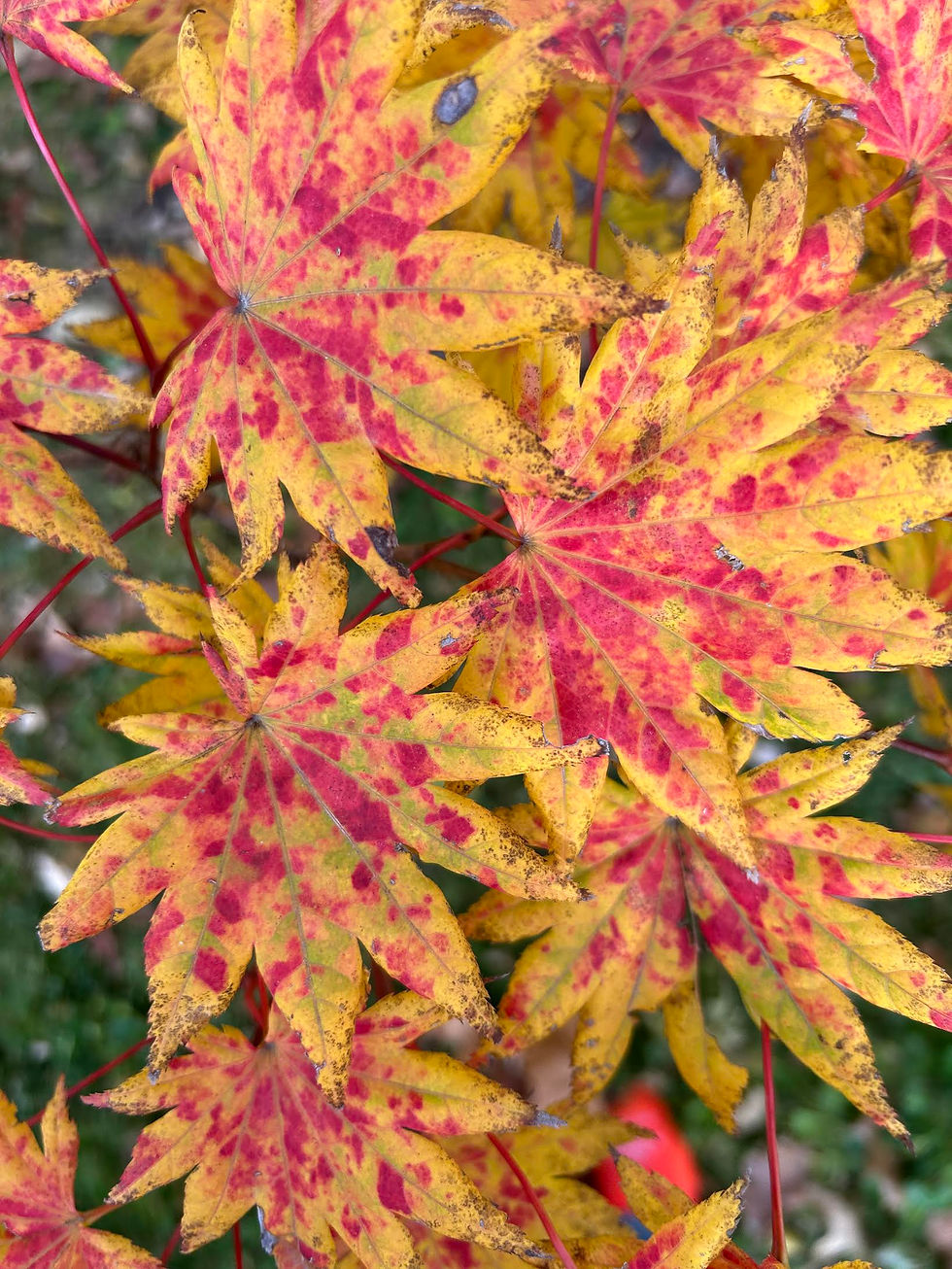
Next up is Acer palmatum 'Koto-no-ito' (see pics below). This gem is very different from the 'Autumn Moon' yet is awesome in its own way. The pics below are near (top) and high fall coloration. The leaves are spectacular, but I have never been able to capture the full splendor (i.e., the truth of the coloration). Specimens seems to glow ember-like and the polymorphic leaves require no promotion. Spring leaves of 'Koto-no-ito' are a lovely soft green accented by dainty dangling flowers which morph into paired samaras, the kind characteristic of maples (see insert pic below). The literal translation of the cultivar name is strings-of-a-koto/harp and obviously refers to the exceptionally narrower kind of leaf segments, some only a few millimeters wide. The preferred common name is Harp Strings and is among the smallest of the upright maples.


I would like to promote Acer japonicum 'Aconitifolium' (Fernleaf Full Moon Maple) to the same degree. No doubt that 'Aconitifolium' is an exceptional lovely plant, but it is rare to find a specimen in the Midwest still there more than a decade since planted as it is susceptible to several soil borne pathogens. Branches commonly die and, like most Oriental maples, specimens usually do not get adequate pruning attention therefore are less pleasing to the eye than they could be. Moreover, the spectacular hand-sized palmate leaves of 'Aconitifolium' get progressively smaller over the years, especially if poorly sited and underwatered. Nor have I seen a specimen in the Midwest over 15 feet tall. The colorful clusters of pendulous spring flowers (see insert pic below), large for an Oriental maple, are also outstanding. If in a more growth favorable part of the world, I would likely call it my favorite maple -- several reasons. Despite the potential issues, it is certainly worth a try. The now largely obsolete name for this beauty is 'Maiku jaku' which translates to dancing peacock! The cultivar 'Ed Wood' has the largest leaves -- obscenely beautiful but it is rarely available. The pic posted below is 'Aconitifolium' in full fall color, as is the lead image in the essay last month. Aconitifolium denotes the resemblance of its deeply dissected palmate leaves to those of monkshood AKA wolfsbane (Aconitum).

Acer palmatum 'Katsura' is noted for its early spring leaf-out and vivid vernal coloration. However, despite the earliness, it rarely suffers late frost/freeze damage. 'Katsura' also has excellent yet subtle fall color but specimens of this cultivar require substantial regular pruning to create and maintain the open look (see pic below) as well as to help keep its size in check. The clustered tight angle terminal branching exhibited by some Oriental maples is pronounced on 'Katsura,' producing unsightly sparsely-leaved leaders (see example in upper R corner, since removed). Maintenance of 'Katsura' is likely too challenging for most, but I enjoy pruning and appreciate the cultivar's uniqueness. The structural beauty of Oriental maples is overlooked -- often best appreciated when leafless and improved with careful pruning. Thoughtful pruning exposes the framework, and sometimes colorful and patterned bark which is always smooth and attractive. The pruning also can produce a layered look and helps promote survival of leaved branches within the canopy thus creating fullness. Additionally, the pruning can also help balance a specimen, helping to prevent what I call photodysmorphia (see Addenda under Book).

As I noted earlier, maples have shallow roots thus are very susceptible to late summer and autumn dry periods. To prevent associated leaf damage, which will reduce both the quantity and quality of the fall color display, one should (if and when necessary, and it usually is) apply supplemental water, doing so to promote deep soaking (i.e., slowly when done). Alas, (1) this advice is probably too late to be a useful tip for the cycle this year and (2) fits nicely under the category planning ahead in last month's essay.
Alas, I suspect my maples likely will last only 12 more years at most since my soil is mostly aboriginal and loaded with developing periodical cicadas. When the last Brood X emergence happened (2021) all my maple specimens suffered, in fact I lost half of the twelve Orientals I had at the time including a gorgeous perfectly formed 2.5-inch caliper Acer palmatum 'Tsuma gaki' due to the resulting damage :( The cultivar name for this beauty translates to painted fingernail (obvious why, see insert spring pic below) but I have also heard and seen it referred to as persimmon nail, the painted fingernail and red fingernail maple. Fall coloration is equally impressive -- variable with yellow/gold replacing the green and the red (now more scarlet) further up the lobes and more diffuse at the color interface. The pic below is that now perished 'Tsuma gaki' specimen immediately after a preceding freak 21 April (2021) 3-inch snowfall. Mind you, there was substantial pre-accumulation melt as the ground was warm, and there was nearly complete melt by the end of day. Surprisingly, the maple was not damaged from the load even though the leaves had already fully emerged. -- I currently have 14 different cultivars of Oriental maples (one of each) although soon to be 15, a replacement 'Tsuma gaki' (if available and when I can afford it) but for a different spot. Moreover, underside branch scarring from the cicada ovipositing is still evident (>5 years later) on all the specimens that survived, maples and other.

EPILOGUE: As for that future event, who's to say I will be around or that I could still notice the emergence and inevitable subsequent damage? What Phil Ochs called "the circle time parade of changes." Twelve more years would put me at 86 years old so that would be an unwise bet. One can always hope but "tomorrow is promised to no one." Regardless, I will continue to admire Nature and respect the land, so should we all. If it happens that I am not around, please do your best to appreciate and enjoy the special event for me -- both the cicadas and the many utterly stupid things some people will again do attempting to avoid impact from the spectacular happening, the red-eyed choir from below.
The pic below (Brood X periodical cicadas on Solomon's seal, Polygonatum) is indicative of what every plant at my place looked like in late May 2021. Some non-woody species were so heavy-laden that I was concerned their stems would snap. Yes, the cicada emergence has some negative consequences, nonetheless IT WAS AND IS an absolutely incredible event. The cicadas are fascinating animals, harmless to humans and just doing their thing. No doubt the nature-averse and bug haters among us would still disapprove. Moreover, since cicadas are members of the insect order Hemiptera, they are "true bugs" thus piercing-sucking mouthparts. Facts I learned in high school biology 60 years ago, have not forgotten and have found useful many times. Natural history is amazing -- so much magic and so many mysteries, yet also suffering too much from the destructive behavior of the dominate animal species (Homo ignoramus) :( If only there was a pill.

Comments